Podcast: Georgios Kabitoglou on leadership, start-ups and Germany's future
Key takeaways
- "Sales is not a department, sales is a state of mind" - every team affects the customer.
- Leadership works like a magnet: it aligns everyone in one direction.
- Clear feedback and room for honest mistakes make people better.
- Germany is still the world's third-largest economy, built on many specialised mid-sized companies.
- Less over-regulation, a digital state and more risk capital would unlock innovation.
About the episode
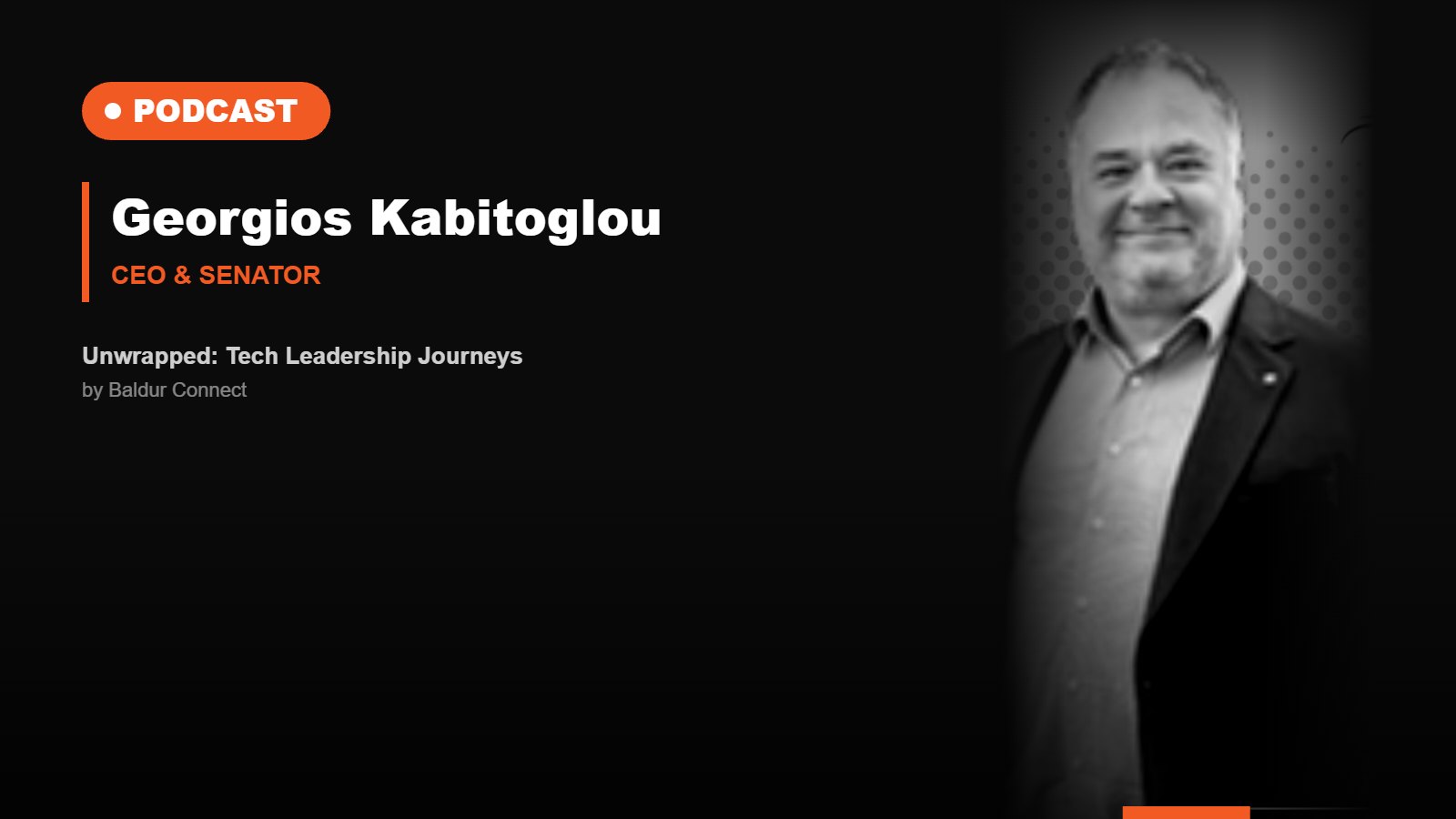
Georgios Kabitoglou was born and raised in Greece, studied electrical engineering at the Technical University of Munich and lived in Munich for 29 years. He has spent his career in sales and commercial leadership across semiconductors, telecom, consumer electronics and industrial companies, several of them private-equity owned, and today leads an industrial group as CEO. He was recently appointed senator at the Senat der Wirtschaft, a network of around 700 business leaders that advises politics. In this episode of Unwrapped: Tech Leadership Journeys, Alex Siletsky from Baldur Connect talks with him about leadership, Germany's economy and what start-ups need.
Listen to the podcast on Spotify
Why is sales a state of mind?
Because every department shapes what the customer gets. When Georgios took over his current company, he wrote ten "commandments" for how people should work together. The first: "sales is not a department, sales is a state of mind". Whether R&D, procurement or marketing - if everyone keeps the customer in mind, the whole company outperforms its competitors.
What makes leadership work?
Alignment. Georgios compares it to magnetising an iron rod: you stroke it with a magnet again and again until all the atoms point the same way. Leadership is the magnet. In practice that means:
- Walk the talk, and hold yourself to a higher bar than your team.
- Be transparent about goals and how you judge people.
- Give clear feedback on good and bad performance - sit down and explain, don't just criticise.
Why does error culture matter?
Because people learn by making mistakes, and in German business culture mistakes are often seen as failure. Georgios told the story of an employee whose wrong signature cost the company around half a million euros. She was not fired. Instead, management improved the processes that had allowed the mistake - and she is still performing excellently. How leaders react in such moments shapes the culture.
Is Germany's economy in decline?
Not in his view. Germany has rested too long on past success, and big shifts like electric cars create winners and losers. But it is still the third-largest economy in the world, with a huge number of small and mid-sized companies that lead their niches. He sees the current crisis as an alarm clock and believes a new renaissance is possible if the right reforms follow.
What would help German start-ups and SMEs?
Less over-regulation, a digital state and access to risk capital.
- Regulation: he values privacy, but sees GDPR, supply chain rules and very long ESG reports as overdone. Regulation is only a burden when it cannot be met efficiently.
- Digitalisation: in Greece, he says, 95 to 98 percent of his dealings with the state now happen online, following Estonia's example.
- Risk capital: German investors fear mistakes, so promising start-ups run out of money. For start-ups, he says, funding matters more than tax breaks.
His advice
Optimism and performance. Fear is a powerful brake, so know your strengths, look ahead positively and take charge of your own business.
What it means for your hiring
- Hire leaders who give clear feedback and set a visible example.
- Look for people who think about the customer, whatever their department.
- Leave room for honest mistakes - and fix the process behind them.
Related: Hiring a CTO in Germany, Account executive recruiting and Expanding to Germany.
Hiring sales or leadership talent in Germany?

FAQ
What is the Senat der Wirtschaft?
As Georgios Kabitoglou describes it, a network of around 700 business leaders who are nominated rather than applying, and who act as a bridge between business and politics.
What does "sales is a state of mind" mean?
That every team, from R&D to procurement, affects the customer, so the whole company should think customer-first.
Where can I listen to the episode?
On Spotify, in the show Unwrapped: Tech Leadership Journeys by Baldur Connect.
Based on the episode of Unwrapped: Tech Leadership Journeys with Georgios Kabitoglou, recorded by Baldur Connect. Quotes lightly edited for readability.
Related reading